Stories in the sand
Every dune, oasis and palm grove around M’hamid El Ghizlane carries a name that tells a story - of gazelles, whispers, saints and dust. Here we explore the fascinating stories behind the names of the places you can visit on our tours.
Place names of the Sahara
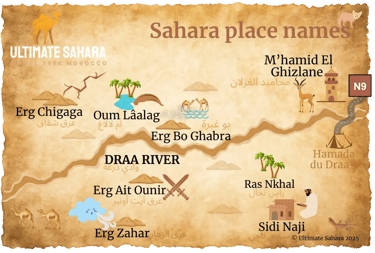
Place names around M’hamid reflect the area’s rich melting pot of linguistic influences, largely drawing on Arabic and Tamazight languages spoken by the Berbers. Words like ait (‘people of’) derive from Berber languages while the likes of erg ('sand dune field') come from Arabic.

M'hamid El Ghizlane محاميد الغزلان
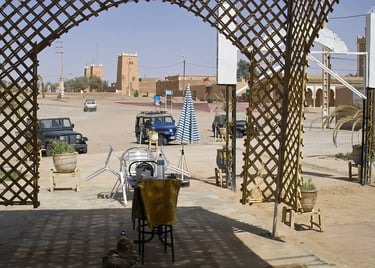
The name of the town where our camel treks begin means plain of the gazelles in Arabic, recalling its once abundant wildlife. Gazelles may still be seen in the desert nearby but are rare.
Once a key stop on the caravan route to Timbuktu, today its position literally at the end of the road – the N9 from Marrakech – has made it a launchpad for desert tourism.
Oued Draa وادي درعة
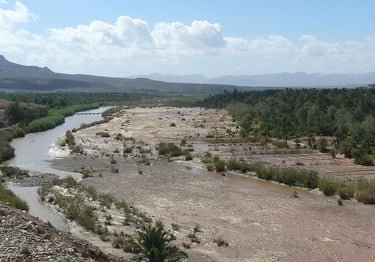
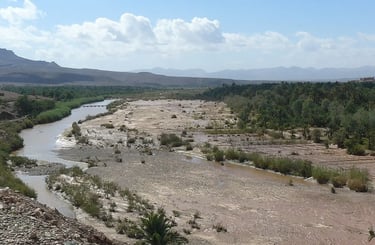
Oued Draa refers both to the River Draa and the seasonal riverbed through which it (sometimes) flows. Morocco’s longest river travels 1,100km (684 miles) from the High Atlas Mountains to the Atlantic.
It once flowed freely through M’hamid, supplying most of its water, but since the construction of the El Mansour Eddahbi Dam, near Ouarzazate, is dry most of the year, leaving M'hamid's once lush oasis increasingly arid.
Oued, commonly used in north Africa, is the French transliteration of the Arabic word wadi (riverbed), more prevalent in other parts of the Arab world.
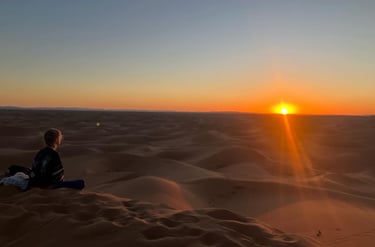
Erg Chigaga عرق شقاق
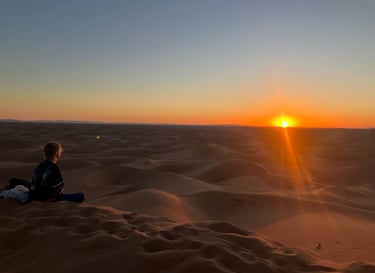
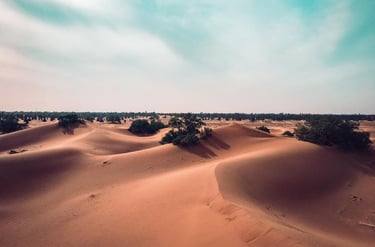
An erg is a dune field, sometimes referred to as a sand sea, covering a large area and containing multiple dunes. The more generic word for a sand dune is rmla (رملة), which also just means sand.
The name Chigaga is thought to derive from an Arabic word for crack, a reference to the fact rainwater once collected there before drying up and leaving crevices large enough for a person to fit in.
It is a suitably poetic name for Morocco’s largest dune field at around 40km (25 miles) long. Experience the view from its 300m peak on our Sahara for Beginners tour.
Erg Zahar عرق الزهار
The evocative name, meaning dune of whispers, is inspired by the mysterious sound of the sand moving with the wind, often to be heard on summer nights when the dunes ‘sing’.
Its remote location – beyond the range of motorised vehicles and reachable only by camel – and unique shape carved out by the wind, only adds to the sense of wonder and mystery when you visit on our Sahara Plus or Sahara Pro tours.
Erg Ait Ounir عرق آيت أونير
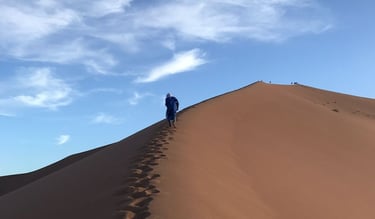
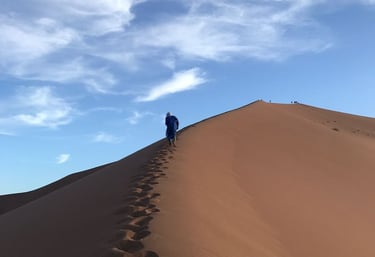
Ait (ⴰⵢⵜ) is a Tamazight word meaning ‘descendants of’, so in this case, the name translates as the dune field of Ounir’s descendants. Legend has it that the Ounir tribe once fought a battle at this spot, defeating a rival tribe and thereby earning lifetime naming rights to this corner of the desert.
Ras Nkhal راس نخال
A common stopping-off point on camel treks from M’hamid, Ras Nkhal marks the point where palm groves give way to open desert, hence its Arabic name, meaning palm head.
Sidi Naji سيدي ناجي
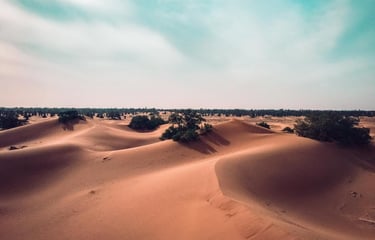
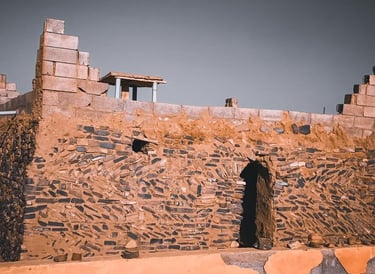
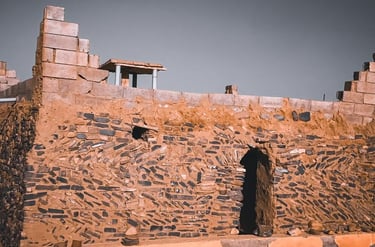
The Arabic word sidi translates into English as saint, or as an honorific like sir or lord. Sidi Naji was a revered marabout, or holy man and this, his tomb, has become a site of pilgrimage among nomad tribes. As at other tombs in Morocco, it's named after the man himself so Sidi Naji is geographic reference as well as a spiritual one.
Erg Bo Ghabra بو غبرة
Bo (بو) is a colloquial form of the Arabic word abu (أبو), meaning father of or possessor of, while ghabra could come from the Arabic root ghbr (غ ب ر), meaning dust. So, the translation is either father of dust or dusty place. It’s a naming style rooted in oral tradition, where places are described by what they ‘have’ or are ‘known for’.
Visit here on our Sahara Plus and Sahara Pro tours and wash in the neighbouring well, also a drinking hole for camels.
Oum Lâalag ام لألاق
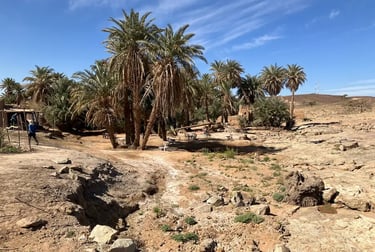
This palm oasis, a stopping point on the 4x4 leg of our Sahara for Beginners tour, is a protected area within the 123,000 hectare (303,000 acre) Iriqui National Park.
The name translates either as mother of protection, reflecting a long-held belief the site was guarded by a protective spirit, or mother of leeches on account of the high number of the vampiric creatures in the waters there.
The latter theory is supported by the fact the word lâalag bears a passing resemblance to the Arabic word alaqa (علقة) meaning leech.
If this has whet your appetite to visit these places, check out our camel treks.